Monday, November 22, 2010

The Thanksgiving Miracle

For those who read my blog, I will divert to an older history than I usually write about. But, if it were not for the story that I am about to share, there would be no Ozarks’ History.

While working in a library, I have the opportunity to see, view, and critique thousands of books. It seems over the past few years, I have been more discerning about my personal collection of books in my home.  Personally, I think some books are not worth the paper they are written on…others priceless. Therefore, my personal library at home is dwindling. I’m getting picky.
 
I have one book that I believe The Father in Heaven has placed in my temporary possession which is a history book of North & South America written in 1849. It is not a politically correct, dumbed-down, white-washed bleached version of history that spins events to ones liking. At times, it reveals facets of the past that we have never been told.  In its’ pages lie a wonderful chain events that prefaces the origin and reason we celebrate Thanksgiving.  

I have a common affinity to this particular story I am about to share, since it was written by Thomas Robbins, D. D. who is my 5th great-grandfather. It’s funny…I have never heard this story before; I wonder why? 
Thomas Robbins, D. D.
August 11, 1777-September 13, 1856
Enjoy.

 “The present year proved to be a year of suffering, in consequence to the scarcity of food. The following affecting account is given by Bradford:  ‘But by the time our corn is planted our victuals do spent, not knowing at night where to have a bite in the morning; we have neither bread nor corn for three or four months together, yet bear our wants with cheerfulness, and rest on Providence. Having but one boat left, we divide the men into several companies, six or seven each, what take their turns to go out with a net, and fish, and return not till they get some, though they be five or six days out; knowing there is nothing at home, and to return empty would be a great discouragement. When they stay long, or get but little, the rest go a digging shellfish, and thus we live the summer; only sending one or two to range the woods for deer, they get now and then one, which we divide among the company; and in the winter are helped with fowl and ground-nuts.’  It is recorded that, after a drought of six weeks, the government set apart a solemn day of humiliation and prayer, which was almost immediately followed by copious supply of rain. In the language of the chronicles of the times, it is thus spoken of:  ‘Though in the morning, when we assembled together, the heavens were clear, and the drought as like to continue as it ever was. Yet (our exercise continuing eight or nine hours) before our departure, the weather was overcast, the clouds gathered together on both sides on all sides, and, in the morning, distilled such soft, sweet, and moderate showers of rain, continuing some fourteen days, and mixed with such sweet seasonable weather, as it is hard to say, whether our withered corn or dropping affections were most quickened or revived, such was the bounty and goodness of our God.’ Soon after, in grateful acknowledgment of the blessing, a day of public thanksgiving was observed. This, by judicious historian, Thomas Robbins, D. D. is believed to be the origin of the annual thanksgiving of New England.”

Reflection:
It is commonly taught today that Thanksgiving was modeled after harvest festivals that were commonplace in Europe at the time. It is rarely, if ever known, taught that Thanksgiving is commemorated because our forefathers humbled, fasted, and prayed for the breaking of a drought. Their answer to prayer was a gentle and mild shower for 14 days off the East Coast…that did not damage crops. To me, that is miraculous. 

Our ancestors knew how to be resilient and yet humble. They were tough old knots with hearts bent toward Heaven.

And to you my dear reader, are there dry places in your life? Honestly, I can see my fellow man’s parched land before I see my own wilderness. But as I pause and look at my accomplishments against my shortcomings, I fail. I know I cannot live without The Lord’s salvation, guidance, and provision. 

Do I still carry my ancestor’s traditions that will increase the faith of my children and the next generation?

Do you?

I ask this one request of you, dear reader. Print off this old story and share it with someone. Let’s dig out and dust off our foundations and prepare for rain.


Work Cited:
Goodrich, Charles A. Great Events in the History of North and South America. Hartfort: House & Brown, 1949.

Monday, November 15, 2010

What a Dollar Can Do.

I couldn't help it.
I just had to throw this on the Blog.
This advertisement was from an old Baxter Bulletin from 1932.
Just think about this the next time you walk into you small town mercantile...or China-Mart.
 Work Cited:
“What a Dollar Can Do.” Baxter Bulletin 31.27 (10 Jun., 1932) 4. Baxter County Microfilm Archive. Donald W. Reynolds Library, Mountain Home, AR. 15 Nov., 2010.

Monday, November 8, 2010

When in Trouble, Head for the Hills.

I will lift up mine eyes unto the hills, from whence cometh my help. (KJV) Psalm 121:1

The hills of the Ozarks have been my companion throughout my life. They are part of the cypher and symbols that always call me back home. It usually doesn’t take over an hour to scale its’ crags and hollers; but, they can forever capture a my mind when I'm far from home or sitting on the front porch in the evening.
In the following article, an Ozark native also considered the Ozark hills as a haven during times of national peril. 
 
 OUR WASHINGTON LETTER
Washington, March 7
The removal of the capital of the United States to the Ozark Mountains in Southwestern Missouri is the startling proposal and in a memorial introduced in the House of Representatives this week by Mr. Shartel of Missouri. The communication comes from the editor of small Missouri paper located at a microscopically undiscovered point and instructs the Representatives in Congress of the “show me” state to introduce bill for the transference of the seat of government as proposed “for sanitary, economic, and other reasons. The Honorable Mr. Elliott, who is responsible for the petition urges the change especially for sanitary reasons, suggesting that a great deal of the inefficiency and crookedness at Washington is possibly attributable to the malarial condition of the atmosphere. Furthermore, he does not like the capital located on one edge of the country, open to the attack of what he calls “the unfriendly powers of the old world” adding that if it were located in the Ozarks such an attack and the consequent destruction would be impossible. Germany might bombard Washington with her war ships, but never a city buried in the mountains of Missouri. Congressman have been quick to appreciate Mr. Elliott’s thoughtful and sympathetic fears for their health and bodily safety but at the same time they seem to prefer the depressing conditions and dangers of Washington to the attractions of Missouri.  The petition has been buried in a convenient cubby hole of the Committee, and it seems to assume that the government will continue to do business at the old stand for a few years more at least. 

Work Cited:
“Our Washington Letter.”  The Bourbon News. Paris, Kentucky 26.20 (09 Mar., 1906) 3. Chronicling America. Library of Congress, Washington D. C. 1 Nov. 2010. http://chroniclingamerica.loc.gov/

Tuesday, November 2, 2010

Ozark Resource Survey


Question: What was the Ozarks like in the 1870's?
Answer: Rocks & Trees

When I was a kid growing up in Ozark County, we always had a fresh cop of rocks every year to harvest out of our garden. Oh the dread of hearing dad grabbing buckets, with a readiness in his voice, in offering me the opportunity to pick up rocks. But, my respite would be at the end of the day...climbing one of my favorite trees in the back field in the evening hours and watching the setting sun. 

Rocks...I did not love. Give me a tree any day.

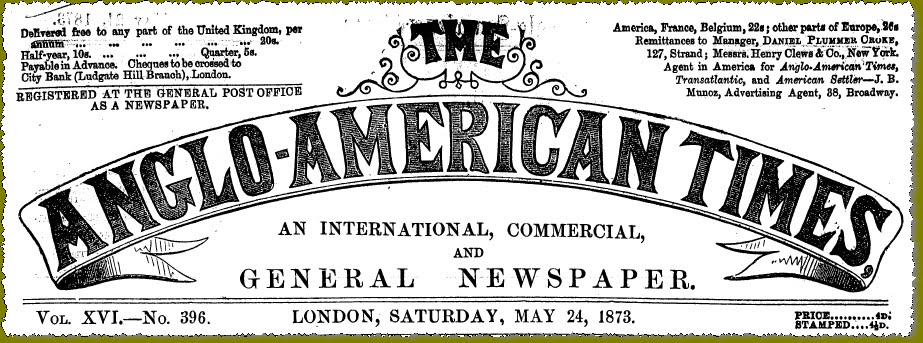
Nevertheless, our rocks have brought attention to this area.  Not only have our rocks brought us to the international spectrum, our forests have also garnered value and beckoned as a ready resource for the Ozark Pioneer. I found this article about the Ozarks from a newspaper called The Anglo American Times, in London, Middlesex, with the date from 1874. This may show a little light and as small survey of our Ozark's History. Though the article may seem a bit dry or dull, The Ozarks had an optimistic view for the people across the pond in England.


 CHARACTER AND RESOURCES OF CENTRAL SOUTH MISSOURI.

We have had so many inquiries about the character of the lands in Southern Missouri, that we publish the following from Dr. L. D. Morris, of Kirkwood, Mo., written to the Western Mural:—

“ Phelps county is remarkable for numerous and valuable deposits of iron ore, and new developments
of great value are continually being made. Simmon's Iron Mountain, in Dent county, is an immense deposit of specular ore, and considerable ore has been mined at Salem and other points between there and Steelville, to be ready for shipment as soon as reached by the railroad.  
Texas County, adjoining Phelps on the South, is a large county; the surface varying from rolling to hilly and broken. In small prairie-valleys, in the valley of the streams, and on a considerable portion of the ridges, is excellent farming land. There is a large quantity of public land, chiefly in the south part of the county, some of it fair for farming purposes, but most of it stony ridges, only valuable for grazing purposes, for timber, or for minerals. There is some pine-land in the interior of the county, of fair quality, still vacant. There is a good deal of iron ore in various parts of the county, some of it promising to yield well, of good quality, chiefly hematite. The St. Lawrence, Salem, and Little Bock Bead, when continued beyond Salem, will enter this county near the north-east corner, and, following a dividing ridge southward, will pass out of it near the middle of the south end. For half the distance or more, it will run through a very good farming region, of clay soil timbered with varieties of oak and hickory. Toward the south end of the county the soil is not so good for cultivation. Doubtless considerable iron ore will be developed along the line. Lead and zinc have been found in the southwest part of the county.  
Howell county has the reputation of being the best in this portion of the State. There is in it a large amount of superior farming lands in the valleys, and a large amount of poor stony ridges. There is a large amount of public land in the county from which may be selected good tracts for farming purposes. It is an excellent grazing region, the whole face of the country, both in prairie and forest, being covered with a luxuriant growth of wild grasses. It is very well watered except in portions of the interior. In the northern part of the county is the best pinery in the State, about 40,000 acres within the county, extending also into Douglas, well watered by springs and clear running streams of water. Hutton Valley, where there are large improved farms, heads at this pinery. There is an urgent demand at that point now for a steam flouring-mill and sawmill. Any one starting a good mill there now would be sure of a good business and might expect an outlet by railroad in a reasonable time. Iron ore is found in many parts of the country, including the pineries, in considerable quantities. In the northwest part some lead has been found, and also a good surface show of a good quality of manganese iron ore.
Douglas County, joining Howell on the west, contains 70,000 acres of good pinery and a large quantity
of public land, much of it of good quality. Large colonies might be located there, even on public land. Iron and lead are found in several localities.  
Ozark county, on the south of Douglas, contains a large amount of public land, about 15,000 acres of good pinery, and a good deal of iron and lead ores. The most important sources of wealth in this portion of the State are its fitness for stock raising, the pineries and minerals. With the rapidity with which railroads are being pushed forward, the time for their development is certainly close at hand. A large part, at least 70,000 acres, of the pineries is owned by the State, for the benefit of the Agricultural College and the School of Mines and Metallurgy, the latter located at Rolla, in Phelps County. The soil is much better than one would expect to find in a pine region. The timber is large, and is a mixture of pine, white oak, black oak, Spanish oak, hickory, and along the streams walnut, hackberry, elm, and sycamore. The proportion of pine varies from one-third to two-thirds. The trees will probably average two and a half feet in diameter; many of them will measure ten feet in circumference and 130 feet in height. An upturned pine tree occasionally shows a depth of the tap root of five feet, and a large ball of gravely clay loam, in colour varying from drab to reddish brown. Farmers say that the pine land will produce better wheat than the best bottom land, and stand drought hotter, which is easy to believe, when the depth of the soil is considered. A considerable portion of the pine lands, however, is too rocky for cultivation, but it is all good fur grass. The college lands are valued at about $1.50 per acre, and may be had, except mineral land, for cash, or on eight years' time. If taken on time by lease, they are exempt from State and county taxes, thus affording a good opportunity for a man who wishes to use his means for improvement, or for one who wishes to lay by something for his children. It is a better investment than life insurance. The timber on these lands can scarcely be worth less than $20 an acre when an outlet is afforded for lumber by railroads. When the late Prof. Shumard was connected) with the State Geological Survey, he made an examination of what was then Ozark county, comprising now Ozark, Douglas, and a portion of Howell. He noted iron ore in eight or ten localities, and lead in three or four. I found iron ore in considerable quantities in a dozen or more localities in the same limits; also manganese of the quality called pyrolusite. Flint, conglomerate and quartz rocks, also crystallized quartz prevail extensively. Buhr-stone, quite like and equal to that imported from France for millstones, is found abundant in the pine regions of Douglas and Howell, and will doubtless be worked with profit at some time in the future. Among the variety of farm crops that are raised in these southern counties may be mentioned cotton as not unimportant. A small patch of half an acre or more has heretofore been raised by nearly every farmer and worked into clothing by hand. About a year and a half ago a cotton gin was put up in connection with a water mill in the south-east part of Douglas County, and many farmers were intending to plant cotton quite extensively, believing that it would become one of their most remunerative crops. They stated that they could raise about 300 to 400 pounds of ginned cotton to the acre. Having been employed in selecting, classifying and appraising Agricultural College lands, I have carefully examined a large portion of the country herein treated of. As a region where desirable lands may now be obtained at extremely low prices and on easy terms, and where a very important rise in value must occur within a very few years, it is certainly well worthy of attention; and especially so on account of its valuable pine timber, iron ore and other minerals. The climate is mild and healthful, and the water pure."

Work Cited:
“Character and Resources of South Central Missouri.”  Anglo American Times, London, Middlesex. 16. 396 (24 May, 1873) 14, 15.  Access Newspaper Archive.   Donald W. Reynolds Library, Mountain Home, AR. 2 Nov. 2010.

Monday, October 25, 2010

Blind Ambition in the Ozarks

If the odds are stacked against you, never say, “ Never.”


Long Horseback TRIPS
BY BLIND BROTHERS
One Rides 36 Miles With Only, His Dog 
for Guide. - All Travel 
Alone.
Marshall, Ark. -  Riding on horseback thirty-six miles from Boyle, Stone County, to Marshall, by way of Big Flat, James Albert Rorie, who has boon blind since five years old, arrived at Frank Rainbolt’s near Marshall, a few days ago.
He came all the way with no one to guide him except his faithful dog. He chained his dog to the bit of his horse’s bridle. The dog started out in the direction that Mr. Rorie pointed. When the dog came to the forks of a road he would trot back and forth until Mr. Rorie motioned either to the left or to the right, and then they would proceed on their journey.
There are three brothers in this family who are blind, the other two being Henry and John.  They go to any place they wish' with no person to accompany them. Last year James Albert traveled over, Boone, Marion and Searcy counties. For a number of years they have operated a broom factory near McPherson, Baxter county.

Work Cited:
“Long Horseback Trips for Blind Brothers.”  Daily Leader.183 (25June, 1915) 2.  Access Newspaper Archive.   Donald W. Reynolds Library, Mountain Home, AR. 1 Oct. 2010.

Thursday, October 21, 2010

Ozark County Refugees in the Time of Civil War

Thankful.

Even when tough times come our way, we can always be thankful for what we have.  Taking a look back in to our Ozarks' History, there was a time of loss & migration, in looking for safety from Ozark County during the Civil War.

And for today..

Though we may see things on the horizon...

May we never crumble to the point of such division and political correctness that we turn against our brother. 

May we always hold our faith resolute to our Father's guiding hand.

May we always bend our will to His and give to our brother in need.


He is more than Providence, as he is intricately working in our lives & this nation.

North or South...Young or Old...Rich or Poor...Unborn or Born.

May we never come to this point of mass hysteria in our nation as to have... An Affecting Sight.


May we throw ourselves at His Mercy, while it is still call Today.


Wouldn't that be An Affecting Sight?


I am respectfully yours,

Vincent 

My email: hebrew613@yahoo.com


An Affecting  Sight.
A long train of emigrant wagons reached St. Louis on Saturday morning, composed of about fifty families from Ozark county, Missouri, who have been driven from their homes by Price's army. The Republican says that on reaching Market street, between Fourth and Fifth, and the levee, the train halted, and a large crowd of people gathered about. A collection of fifty dollars was taken up for the benefit of the suffering refugees. Their destination was Illinois. They represent that they have been stripped of everything of any value which they formerly  possessed by the rebels, and also state that one thousand families in the same condition as themselves are now on their way to St. Louis. 

Work Cited:
“An Affecting  Sight.” The Smoky Hill and Republican Union  1.14(26 Dec., 1861) 1. Chronicling America. Library of Congress, Washington D. C. 1 Oct. 2010. http://chroniclingamerica.loc.gov

Wednesday, October 13, 2010

Why is it called "The Ozarks?"

How did the Ozarks get its’ name?
It seems I get this question about 3 or 4 times a month from visitors to the area. Well, to answer that question, I have found an old article from 1932.


Confronted with many questions of varied nature the Jefferson city Chamber of Commerce which has become adept at answering queries, almost met a Waterloo Thursday when an elderly couple, en route home from a vacation trip at, the Lake of the Ozarks, stopped here and asked what the meaning of “Ozarks" happened to be. After a search, which for a while proved  discouraging, the chamber found a report by Miss Jeffries in a Lake of Ozarks publication which explained that, the derivation of Ozarks was from the French "aux arcx," which means "with bows and archery", and not from the Indian as has been popularly supposed. "When the explorations of the French carried them into this j section, the only known inhabitants were Qaw Paw Indians, a branch of the Sioux. They migrated here from the Ohio and Illinois rivers when the white man came," Miss Jeffries said in her explanation. "The French established the first trading post, Aux Arcx in this bow and arrow country. Later the Spanish came questing for hidden gold. Many of their hidden treasures, repose no doubt, beneath the Lake waters of the new inland sea." The local Chamber of Commerce invites anyone having a different explanation for "Ozarks", to write and tell them about it.

Work Cited:
“Ozarks is from the French, The Bows and Archery.”  Jefferson City Post-Tribune 66.183 (15 July, 1932) A1-1.  Access Newspaper Archive.   Donald W. Reynolds Library, Mountain Home, AR. 1 Oct. 2010.

Wednesday, September 29, 2010

Bill Clark, Deer Slayer & Bee Hunter

I would like to begin by saying thank you for the temporary breather since I have been away from my blog. I am in the middle of establishing a Local History & Geology Room in the new Donald W. Reynolds Library. It is a big challenge that can stretch one’s nerve a bit. But, the lessons of doing things different and new are always rewarding.

Every new task can hone our skills & temper and show your areas of improvement. It requires us to grow. I use to think consistency was a good thing. And in some terms it is. But Bernard Berenson once made a quote that has stuck with me; he said, “Consistency requires you to be as ignorant as you were a year ago. “
I can look back over my life and see some areas I could call consistent when it is really an excuse to stay comfortable.

Thank goodness for growth.

As things are gearing up at work for our library’s grand opening, I was putting some of my favorite books into their new home. One of those treasured authors of times past was Silas Claiborne Turnbo also known as S.C. Turnbo.  I ran a quick search and discovered one of his articles from The Harrison Times in 1901that tells one of his great old stories. This is one of the many Ozark tales that can be read that was once published in local Ozark newspapers.
Enjoy.


BILL CLARK, THE DEER SLAYER AND BEE HUNTER
Bill Clark was well known many miles along White River. Almost every pioneer settler in Taney and Ozark Counties, Mo., and Marion County, Ark., knew him, or had heard of him, for his fame as a hunter went far and wide. As a deer and bee hunter he had but few rivals. It is told of him that he never done but few day’s work on a farm, entirely depending on hunting for a living. When he was hungry for bread he would approach a farmer and purchase a turn of corn on credit, promising to pay for it with a fat buck. It might be a month or a year before he fulfilled his promise, but it is said he hardly ever failed to bring the deer according to contract. He tramped the woods so frequently in search of game that the front part of his pant legs unless they were made of tanned buck hide were worn into tatters by the saw briars. To avoid the wear and tear on his pants he would often step high through the grass like a blind horse.

Referring to his renown as a bee hunter, a settler who lived on White River sent for him one day to find a bee tree that he and others failed to locate. When Clark arrived several men were sitting around watching the bees alp the bait. Some timber prevented the men from getting the proper direction the bees came and went. Bill seated himself to watch the bees for a few minutes, then he stationed himself on the bank of the river. He soon discovered that they flew across the river (his eyesight was so good he could see the flight of a bee a long distance). After getting the direction the bees flew he prepared to locate their home. Every man in the crowd had his eyes on Clark, for he was acknowledged to be a great bee hunter. Soon he noticed a bee heavily laden, which flew very slow. Bill watched it intently and said to the men, "Look, boys, look, look, look, boys, look. Into a tree it went, by jacks." His eyes had followed the bee into the face of a bluff on the opposite side of the river and saw it go into a tree. The men crossed the river in a canoe and discovered the bees in the tree Bill had named. He had located the tree in less than half an hour, where others had hunted for days and failed to find.

I remember seeing great numbers of wild bees visit our spring on Elbow Creek in 1850. The direction they came and went indicated that there was more than one hive nearby. Father was not a bee hunter, but he enjoyed eating wild honey and he sent for Bill Clark and when he made his appearance which was in a day or two father employed him to find bee trees. I was only six years old, but I recollect how Clark coursed the bees from the spring.

The hunter seated himself near where the bees were sipping the water and watched those that flew across the creek; then he ran and followed one to the creek and halted and waited for another one. In a few seconds another one appeared which flew just over his head. Bill began to repeat the words, "There it goes; there it goes; there it goes; over the hill it went, by jacks." Then he climbed the bluff on a line the bee had went and stopped on the top of the bluff where he saw the bee pass over. In a little while another bee went buzzing just over him. His eyes quickly perceived it and I heard him sing out, "Yonder it goes! Yonder it goes! Yonder it goes into a post oak tree, by jacks." The man had located it in a few minutes. Returning to the spring he proposed to find another swarm in less than an hour. Another course was followed west from the spring. Some timber intervened and so obstructed the course that Clark had some difficulty in finding the tree, but in about 40 minutes he treed the bees in a large cedar tree a few hundred yards from the spring. The bees went into the tree near the ground.

In the early forenoon the weather was clear and bright, but soon after locating the swarm in the cedar tree the sun was hidden by clouds which broke up the bee hunt. Going to the house for ax and vessels the hunter chopped a big block out of the tree and exposed to view a fine quantity of rich honey comb which filled the cavity in the tree. Rain began falling while we were feasting on the honey. In a day or two we felled the post oak tree on the creek bluff that Clark had found first, but it contained only a small amount of honey.

Many years ago when the fine valley of Big Creek in Taney County, Mo., was wild, Bill and his brother, Calvin Clark, were hunting one day on the right hand prong of the creek. The weather was warm and the weary hunters had stopped at a spring of water to quench their thirst. Before either one had time to drink a bee alighted and began sipping at the water. Bill remarked, "By jacks, Mr. Bee, I will find your house before I drink of this water."

Both men waited patiently until the bee filled itself and started. Bill watched it move off and followed it with his eye and saw it enter the cavity of a post oak tree just 15 paces from the spring. This proved to be a rich tree and the comb had a peculiar formation. The tree was large with a big hollow. A column of honeycomb was on two sides of the cavity, from the ground to seven feet above where the hollow terminated. From the center of the termination of the cavity was a round column of rich comb three inches in diameter and 2 ½ feet in length, which hung between the two columns of the main comb. It was held in place by a small neck—the lower part was not attacked to anything. Both of the men said that the formation of the comb in this tree was strange to them.

As we have given some samples of how the noted hunter located bee trees we will now relate some stories of how he slew wild turkeys and deer.

One night in the month of January, 1844, while his father, Billy Clark, lived at the mouth of Shoal Creek just over the line in now what is Boone County, Ark. He and his brother, Calvin, went up to the upper end of the river bottom above the mouth of the creek to shoot turkeys. Great numbers were roosting in the timber. The night was cold, but it was brilliantly lighted up by a full moon. In a large sycamore tree the limbs were crowded with turkeys. Both men took a station at one tree and shot, time about, until 14 fat turkeys fell dead. Thinking it wrong to kill more than they could make use of for awhile, they ceased the slaughter and swung the dead turkeys on a pole and carried them home.

Where the little hamlet of Dugginsville, Ozark County, Mo., now is, is several fine springs of water. Here on this spot of land Bill Clark often camped and killed scores of deer on Cedar Creek. The hills and valleys in this section were a garden spot for deer. Some 200 yards from the main spring, Bill said that he killed the largest buck he ever saw. The animal was so fat and heavy that it gave him and his brother Calvin a hard lift to carry it to camp at the spring. Campbell Barry, who was then County Clerk of Taney County, had offered a fine pocket knife as a premium to the hunter who brought in the largest buck hide in proper shape. Clark said that the hide from this buck after being well dried weighed 12 lbs. and 2 oz. at Forsyth. Bill took in the knife by a close call, for another hunter had brought in a buck hide that weighed 12 lbs. and one ounce. Besides the knife he received 30 cents per lb. for the hide.

On another occasion Bill, accompanied by his brother Calvin, were on a camp hunt at this last named spring on Cedar Creek. The men needed a supply of pelts more than they needed venison. This time out they killed deer for the hides only. They soon killed enough for a fair load. One morning the wind was blowing brisk and the hunters thought they would have no success that day on account of the blustery weather. But they went out to try their luck at least. Just below the spring on the creek they met a herd of deer which divided, and each man followed a bunch of them. The deer were not wild and soon stopped. Calvin said that he killed three of them as fast as he could load and shoot. The second one fell across the first one and the third one fell in a few feet of the other two. The other deer ran off.

"In the meantime," said Cal "I heard Bill shooting, and knew he was putting in good time. When he quit firing I went to him, he being near ¼ mile from me, and found that he had slain four deer and they were all lying within ten feet of each other. This was seven deer killed in a few minutes. This gave us a spell of work to remove the hides. We had enough green pelts on hand now to care for, and we loaded them on our ponies and returned home. At the mouth of Shoal Creek." Bill Clark has left his earthly hunting grounds and has passed over to the other shore where we hope he is "resting under the shade of the trees." His death occurred in the month of May, 1886. He died on the south side of White River above the mouth of Little North Fork and just below Blanket Bottom. On the 26th day of December, 1905, as I stood on a hill on the north side of the river and viewed the locality where the old pioneer hunter gave up his unerring rifle to occupy his resting place under the sod my heart seemed to throb slower then it beat faster at the memory of this man who once was so noted among the wild bees, wild turkeys and deer. After his death his family and friends conveyed his body to the north bank of the river and deposited it in a grave dug in the cemetery in the lower part of the bottom opposite the mouth of Music Creek. Clark had hunted until he was too old and feeble to follow the fat bucks or kill the big fat gobbler or hunt the rich bee trees.

A few years ago the writer met his widow, Mrs. Celia Clark. She was at that time residing near Dugginsville, a part of her husband’s old hunting grounds. She is a daughter of Arch and Elizabeth Tabor. Her mother was a daughter of Tommy Morris who died on Big Creek in 1858.

In referring to old times on Big Creek Aunt Celia Clark said that, "some of the women in the early days knew how to use a rifle as well as men. One evening in 1840, when I was about ten years old, " said she, "I went to Uncle Isaac Tabor’s to stay all night. Next morning before breakfast a large flock of wild turkeys alighted in some trees near the house. Uncle Isaac was gone but Aunt Tilda, his wife, says, "Let us have turkey for breakfast." Then she took down the rifle and walked out into the yard and taking deliberate aim at a fine gobbler, shot and killed it."
S. C. Turnbo

Works Cited:
"Bill Clark, The Deer Slayer And Bee Hunter." Harrison Times 25.31 (09 Feb., 1901) 4.  Donald W. Reynolds Library Microfilm Archive. Baxter County Library, Mountain Home, AR. 1 Dec. 2009.

Turnbo, S.C. (1994). The White River Chronicles of S.C. Turnbo : Man and Wildlife on the Ozarks Frontier / selected and edited by James F. Keefe and Lynn Morrow ; introduction by W.K. McNeil.

Monday, July 26, 2010

It's Getting Busy


First, I would also like to say, "Thank you" to the Ozark County Genealogical & Historical Society for their invitation to speak last Thursday, July 22nd, in Gainesville, Missouri. I enjoyed your warmth & hospitality.


As many of you may know, our library won a $10 million dollar grant from the Donald W. Reynolds’s Foundation. Therefore, in the next 6 weeks, I will be in the process of moving my genealogy, books, and stuff from the Baxter County Library to our new home across town. A picture of the new library is posted above.

With this entire hullabaloo going on, I will not be able to post as much on Ozarks' History.

Try to keep cool in these Dog Days.
 
Vincent

Saturday, July 17, 2010

Adventures on Fox Knob in Ozark County

The Origin of Fox Knob
While growing up in Ozark County, I was always entranced by the old stories I heard about gold, silver, and lead mines in the area. It just so happened, one was within a stone's throw of my home in Mammoth. There's a story of Mr. Walrath having a dream of a particular geographical location in which he was to find, move his family, and mine its’ riches. The location was at the confluence of Lick Creek & Possum Walk Creek in Mammoth. Upon finding the lay of the land to his prognostication, he began his endeavors. The location of the mine was on top of a hill called Fox Knob.

Old Newspaper Stories
I happened to come across some articles recently, and it brought back memories of stories I once heard.  The authors of these articles never disclose the exact location or owner of the mines. But, I would like to think he was talking about Fox Knob.


Dreams hardly ever come true. A few weeks ago an Ozark county man dreamed he found a gold mine on the hills of his farm. The dreamer had little faith in visions and tried to forget the incident but without avail. At last, just to prove there was nothing in the dream, he took pick and shovel and started to work about 100 yards from his home. His doubts were confirmed for all he found was a rich load of zinc which promises to make him one of the richest men in the county.
End of Article


                            End of Article

Gold?
While I was looking into mining in Ozark County, I also came across this little snippet. Even though the newspaper is worn and faded, it packed a huge word...Gold.

 
Gold has been found in paying quantities on Pond Creek in Ozark county, Missouri
End of Article

Though I know these articles were not about Mr. Walrath, it tells of a time when the mining rush was on in the Ozarks. In the past Ozarks' history, mining was a viable way to eke out a living.  A couple of years ago I did a survey on the old mines in Baxter County, Arkansas,  in 1901, which is linked HERE. Baxter County had a total of 154 registered within its’ county borders in 10 districts.

Though the Ozarks never yielded its’ precious hopes of great mining wealth, it is one of many threads that weave our Ozarks’ History.

Back to Fox Knob
The interesting thing about Fox Knob is it stood across from my house. Beside the old mine shaft stood a tall and solitary white pine tree towering over the other hardwoods on the hill. This tree was one of the focal points from our front porch. As a child, I remember dreaming about being old enough to climb to the top of Fox Knob and discovering the treasure that had once eluded its’ former caretaker.


The view from my childhood home on the front porch with Fox Knob in July, 1980.
Double click on the photograph to enlarge, then fine one of my favorite lone pines.


The view from Fox Knob in March, 1985.
Notice the second ridge behind my house, it's the Arkansas State line. 


Fox Knob is located above a well known swimming hole on Lick Creek called, “The Big Rock.” When I was 14 years old, I rode my motorcycle to the creek, and climbed Fox Knob’s steep grade. I had a camera in hand to document my adventure and a 50 foot garden hose. Why a garden hose? I didn’t have a rope. I know I looked ridiculous, but at that time, I didn’t care. Believe it or not, I was convinced that I was Daniel Boon. Upon reaching my destination, I tied the garden hose off on a small tree, wrapped the other end around my waist, and lowered myself down about 10 feet. The sides of the shaft were a mixture of chert & clay. At that moment, my fear or reality set in, and I pulled myself out of the small abyss. Afterward, I snapped a picture. 

In doing the math, I be 45 years old in September; this experience took place December 27, 1979. 


The Vertical Mine Shaft of Fox Knob


Warning: Rabbit Trail
That was a great garden hose. This hose came from a relative who worked a Baxter Lab. It was a clear thick hose entwined around a spool. For some reason it was a reject, and it ended up at my house. This is the same garden hose I would tie to a tree on the banks on Lick Creek, put the other end in my mouth, grab a big rock to eliminate buoyancy, and sit on the creek bed to watch the perch & sunfish swim around me. If I was fortunate enough, I might see a beaver, muskrat, or snake swim overhead. I got this idea from the book 20,000 Leagues Under the Sea, by Jules Verne,and the old TV show The Man From Atlantis, starring Patrick Duffy. Others may call it foolishness; I call it Redneck Scuba Diving.

Back to the Story
Exiting this steep hill was relativity easy. Halfway down, I would sit on my bottom and slide down the hill. If I would go too fast, I would simply grab hold of a tree sapling or dig my heels in and slow down. Even though this would wear the seat out of my jeans, I knew there wasn’t a pair of jeans Granny Anderson couldn’t mend. I will say this is also a great place to start a small avalanche, if one were inclined to do so. It was rumored at one time a few teenage boys attempted such a feat. But, my sources tell me..."We're not talking." 


The steep access to Fox Knob from Lick Creek 


Reflection
I’ve ventured to Fox Knob at other times, but my first experience was a lasting one. There is an old song my dad will sing in church every so often. The words are hauntingly familiar to that time of my life and many other of life's circumstances. 
  He brought me out of the miry clay,
He set my feet on the Rock to stay;
He puts a song in my soul today,
A song of praise, hallelujah!

Climbing out of that clay covered abyss has ingrained a few lessons of life for me. 

#1. Don't do stupid stuff by myself.

#2. Know my Deliverer.

#3. Listen to His Voice.

As I left Fox Knob the first time, I could look back in the snow and not only see my foot prints in the snow, but my clay covered boots left its' stain as a reminder of my deliverance. I remember taking a stick and trying to completely clean off all the clay on my boots in Lick Creek to no avail. To my surprise, I discovered this clay coating kept my boots waterproof in the chilly waters; it's another lesson of God's wisdom. The mire of sin & error is not easily cleansed, but redemption brings its' deliverance.

Some people have journeyed to this area through the promise of a dream, hope for an adventure, or a longing to create family memories. Though I no longer live in Mammoth, in my heart, it is still called home. For me, it will continually contain a part of my dreams, adventures, memories, and lessons of my...Ozarks' History.
 
Work Cited:
“Discovery of Famous Silver Mine.” Wheeling Register 27.211 (11 Feb., 1890) 7. Access Newspaper Archive. Baxter County Library, Mountain Home, AR. 1 Nov. 2009. http://access.newspaperarchive.com
 “News from All Over Imperial Missouri.” St. Joseph Observer 9.20 (19 Feb., 1916) 3. Access Newspaper Archive. Baxter County Library, Mountain Home, AR. 1 Nov. 2009. http://access.newspaperarchive.com
“Telegraph Tips.” Houston Daily Post 9.294(25 Jan., 1894) 6. Chronicling America. Library of Congress, Washington D. C. 1 Nov. 2009. http://chroniclingamerica.loc.gov/
Zelley, Henry J. 1898. "He Brought Me Out." Gospel Publishing House, Full Gospel Songs (47).

Sunday, July 11, 2010

There’s Trouble Across the Line - Part 5

This is the Last Installment of "There’s Trouble Across the Line."

Bill Naves Not Guilty.
The trial of Bill Naves on the charge of assault with the intent to kill, committed against I. N. Lantz in July, 1902, came up last Tuesday Morning. The State was represented by prosecuting attorney Garner Fraser, assisted by W. S. Chastain and B. F. Fee, while Seawell, Jones and& Seawell appeared for the defense. Most of the fornoon was consumed in selecting a jury which was composed of C. J. Cook, Tom Ott, S. J. Dodd, A. A. Thompson, Will Briggs, Bert Record, Hance Underwood, J. H. Davenport, W. C. Wood, B. B. King, J. T. Gilley, and Jack Matlock.

After the opening statements to the jury by prosecuting attorney Fraser for the state and T. M. Seawell for the defense, and the introduction testimony began, Mrs. Luntz being the first witness. She stated on the night of July 23rd, 1902, while she was clearing up her kitchen work after supper, the dogs ran out and began barking and she stepped to the door, while her daughter, Malinda, stepped out into the yard, and a man rode up to the yard fence. He spoke and asked which way Mr. Lantz was. She recognized the voice as that of Bill Naves, and supposed that he had come to stay the night, as he frequently visited them. Mr. Lantz had lain down and was asleep, and Malinda went into the house, awoke her father, and told him that Bill Naves was out there and wanted to see him. Mr. Lantz went out to the fence in his night clothes and asked him what he wanted, and he said: “Nothing much.” Mr. Lantz then invited him to get down, and about that time she saw a flash and heard report of a gun, Mr. Lantz hollered and said he was shot. The man on the horse dashed away. The testimony of Malinda and Delia Lantz was essentially the same as that of their mother. Mr. Lantz testified that when he reached the fence he put one foot in the crack of the fence and place his left hand on his hip, asked Naves what he wanted and his answer was the same as stated by Mrs. Lantz, and while he was standing in that position, the gun was fired, inflicting a flesh wound in his left arm and some of the shot glanced his left side. He said that he never, at any time, saw the gun. He knew it was Bill Naves on the horse and made no effort to conceal his identity. When the gun fired, his horse whirled and dashed away. That the shooting occurred between 8 and 9 o’clock.

Myrtle Turnbo, a cousin of the defendant, testified that on the night before the shooting took place, Bill went to their house and got her father’s shot gun while he was away.

Andy Turnbo, father of Myrtle, and uncle of the defendant, testified on the night of the shooting he returned home from Pontiac at 10:40 o’clock and found Bill Naves on his porch, apparently asleep, and he stayed until the next morning. He said that it was between 7 and 10 miles from his house to the Lantz home.

Here the State rested and the defendant took the stand in his own behalf. Asked by the attorneys to tell all he knew about the shooting that occurred on that fateful night, he said:

“I will do that as best I can. In the year 1902, I made a crop at home with my mother, who was living on Uncle Newt Turnbo’s place. In the early part of June, I was over to Uncle Newt’s house and he began telling me about people killing his cattle. He said they were cut to pieces, shot, crippled, and killed because the people did not want them to run on the range, and that he begged them to let his cattle alone as he was old and could not look after them himself, but that his pleas had been disregarded. I said it looked like those people could be prosecuted for these acts, but he said that he had tried and failed, but that he had a scheme which he had been thinking of naming to me. I asked somebody ought to take a shot gun and give some of those fellows what they had been giving his cattle. A few days later, he asked me if I had thought about this matter any, and I told him I had not for I did not think he meant it. He said yes, he was earnest, and he thought I ought to help him out as he had been good to me, which he had. I told him I would think about it and he asked me if Bill Shaw would be all right to go with me. I told him I would have nothing to do with Shaw in a matter of that kind because I had no confidence in his keeping it. Uncle got mad and said he did not believe I wanted to help him, anyway. That ended the subject at that time. A few days later Bill Shaw came to our place and said uncle Newt Turnbo wanted me to come over. I went, and uncle was very angry. He told me to look at his cattle, some shot and some badly cut up. I asked him if he knew who did it. He said Tom Clark did it. I asked why he did not have Clark prosecuted and he said he didn’t have evidence. He said that Clark, Sam Frost, Hillhouse, and Jerry Jenkins were doing this killing and if they were run out of the country, it would stop. He said he had talked to Mr. Lantz who had told him he would look after the killing and report. He asked me again if I had made up my mind to help him. I told him I was already in trouble and couldn’t afford to do it. He said, “Bill, if I thought there was any hereafter about this, I would not ask you to do it, but I will see that you come out alright.” I again refused to go with Shaw, and uncle got mad and said that he had always stuck by me, was then on my bond but that I might now get another man to go my bond. I then told him that if he would get a man that I could depend on to go with me I would do what I could for him. He asked me how Sam would do, meaning his son. I said that Sam would be alright. Uncle then promised me that if I got to any trouble over the matter, he would stick to me and see that my brother was taken care of. Sam came to see me in a few days and we went out into the hills to several watering places but found no crippled cattle, but we saw Tom Clark in the woods with a gun. As we went home Sam said it looked like the old man was about right, which it was no use trying to get evidence and he asked me how my nerve would be on shooting a man. I told him I couldn’t tell as I had never tried it. He said he didn’t know whether he could hit one or not, so he practiced, shooting at trees a few times along the road and hitting his mark well. He then said, “Yes, the old man is right and some day we will go out and take a shot a piece.” I went out into the hills alone next day and found a wounded steer lying near Tom Clark’s place. He was nearly starved and I carried water in my hat to him to drink. In about a week Sam came up to his mother’s gate and called me out and said: ‘Well, what about our trip?’ I told him I had hoped he had forgotten it. He said he had not, but wanted to get it off his mind. I asked if it was coming off that night, and he said no-tomorrow night. So next evening I went up to Uncle Andy Turnbo’s and got his shot gun , and Sam and I met at the appointed place about an hour before sundown. He had some whiskey and we took two drinks a piece. Sam said that he had changed the plan, that it would be easier to track two than one, and that it would be best to separate and each go alone. He asked me where I wanted to go, and I told him it was immaterial. He said then that I could go to Tom Clark’s and Sam Frost’s and he would go to Hillhouses’ and Jenkins’. So I started out and got to thinking that Sam might not intend to carry out his part, and I came very near turning back. Then I thought of the way my uncle’s cattle had been treated and that if ever two men needed a taste of shot it was Tom Clark and Sam Frost. So I related my courage and rode on. When I got near Clark’s house I dismounted, and, leaving my pony, walked up to the house. It was after dark. I called, and a woman and a little girl came in sight. I asked to stay all night and she said she couldn’t keep me as her husband was not at home. I was glad to hear her say that and felt relieved. I decided that, as I could not get Clark, I would not bother Frost, either, so I started back, thinking that I might stay all night with Mr. Lantz, as he lived on my route home, and then I wanted to talk with him about this cattle matter. I rode up to the fence when Mrs. Lantz and one of the girls came out, I asked if Mr. Lantz was at home and the girl, saying he was at home, went into the house. It seemed to me that he was rather slow about coming out, and I wondered if he had become worked up over reports that had been circulated, and was fixing to come out prepared to give me a load of shot. When he did come out he walked right to me before speaking, and then he asked, and what seemed to me, a rather harsh tone, what I wanted, and , at the same time, I saw his left hand go to his left hip, and I thought he might be preparing, thought he might be reaching for his pistol. As he did that, I pulled back on the hammer of my gun, which lay across the pommel of the saddle before me, intending, if he brought a gun in sight, to shoot him in the arm. By taking a second look I saw that he had on only his night clothes and did not intend to harm me, so I started to ease the hammer of the gun back down when it slipped under my thumb and the gun fired My horse leaped a few jumps, and when I got him stopped, the women were screaming and I was afraid I had killed Mr. Lantz. I thought one I would go back, but I saw one of the girls come out of the door with a Winchester and I left. I had no desire to harm Mr. Lantz, and if I wanted to kill him I could have done so with the greatest ease. A short time after I had left the Lantz’s home I heard and gun fire and then I knew Sam was out. I went to Uncle Andy Turnbo’s house and was on the porch when he came home, as he testified, having in mind the chance to prove an alibi in case Lantz died. Ike Turnbo was the first to mention to me about the shooting. He said they were accusing me of doing it.’ That the people were all stirred and Pontiac was surrounded by men hunting me. I then decided to go to Oakland and give up to the sheriff of Marion county, which I did and was turned over to the constable to await preliminary hearing, being release on my own recognizance. While waiting for this hearing Sam Turnbo tried to get me to leave, offering to furnish me with money to do so; criticized me for giving up and asked me what I meant by killing Lantz? I told him it was accidental, and asked him what he meant b killing the Lantz’s boy? He said he did not intend to kill him. I waived examination and was turned over to the sheriff of Baxter county on the charge of killing Ike Lantz’s boy-taken to Mountain Home, lay in jail 14 months, was tried and acquitted. While in jail, there Uncle Newt Turnbo sent me tools with which to break jail and get away. I them back to him without using them. After my acquittal at Mountain Home, I was taken t West Plains, Mo., tried on the charge of shooting Jerry Jenkins, convicted, and had served three years in the Missouri penitentiary. I have told the truth and nothing but the truth here. I did not tell the truth at Mountain Home because I was on trial for my life, and did not want to say anything unfavorable to myself. I did not want to tell the truth at West Plains because I would rather suffer unjustly myself than untrue to my confederates when I thought they were still my friend. Since my imprisonment I have learned that they have turned against me, forsaken my mother, mistreated my sister, and I don’t feel under any obligations to shield them further in this matter.

In corroboration to the testimony of the defendant, Wm. Nelson testified that Newt Turnbo had told him about his cattle being killed, that he believe Sam Frost was one of the men who was doing the killing and he wanted to get someone to look after them as something had to be done.

H. H. Perkins testified that Dr. Sam Turnbo was boarding with him at the time the shooting was done. That he left his house on the evening before the shooting that night and was not at home at breakfast time next morning, although he came later. The above is the gist of the evidence produced in the case by both sides.

Naves can yet live down the stain upon his character and become a good and useful citizen.

The above article comes from the Yellville Echo. Naves was tried at Yellville last week by the Marion county circuit court.
End of Article

My Reflection
Bill Naves’ ordeal has taken him from a little place called Pontiac, Missouri, in Ozark County, to crossing the Arkansas line, and many other county lines in the Ozarks. Some would say he knew how to play the system, but others testify to his enduring innocence. Was his conversion in prison only a “Jail House Religion?” Though I am not offering stones to throw, I believe it was an interesting admission in Post #2. This is where he stated he had to lie in Mountain Home because he knew his life was on the line. Not only did Bill Naves cross geographical lines, by his own admission, he realized he crossed many moral lines.

I believe, due to our nature, we too have transgressed many lines in our lives. It may be easy to see the blatant faults of our neighbor, but it takes a greater courage and humility to acknowledge our sins and shortcomings. As we now let William “Bill” Naves rest in peace in our Ozark’s History, may we also make amends with our Creator and neighbor while it is still called “Today.”

Thank you to those who have called or emailed concerning There’s Trouble Across the Line.

Comments? My email address is:
Work Cited:
“Bill Naves Not Guilty.” Baxter Bulletin 6.34 (16 Aug. 1907) 3, 6, 8. Baxter County Microfilm Archive. Baxter County Library, Mountain Home, AR. 1 Dec. 2009.

Tuesday, July 6, 2010

There’s Trouble Across the Line - Part 4

Hard Times
After fulfilling the allotted time in the Missouri State Penitentiary, Bill Naves will be met by Marion County Sherriff Magness and escorted back to Yellville, Marion County, Arkansas.

B and C Hall, Missouri State Penitentiary, Jefferson City

14 June 1907

Sheriff Magness and Bert Record returned Sunday evening from Jefferson City, Mo., where they had been to get Bill Naves who is wanted in this country charged with having shot Ike Lantz on the night of July 23rd, 1902, and who had been liberated from the penitentiary at that place for shooting Jerry Jenkins on the same night that he is charged with having shot Lantz. Naves, being unable to give bond, was placed in jail Sunday evening, where he will probably remain until August term of court. Sheriff Magness was very much impressed with the management of the Missouri penitentiary. He says all their prisoners are worked on the inside the prison walls, in the manufacture of various article, such as shoes, overalls, jumpers, saddle trees, which he thinks is far better than the lease system which is in vogue in this state – that they are well fed and humanely treated.
End of Article

Comments? My email address is:
There’s Trouble Across the Line - Finial Post...Coming Soon

Works Cited:
“Bill Naves at Yellville” Cotter Courier 4.30 (14 June 1907) A1-1. Baxter County Library, Mountain Home, AR. 1 Dec. 2009.Baxter County Microfilm Archive. Baxter County Library, Mountain Home, AR. 1 Dec. 2009.

Photo: B and C Hall, Missouri State Penitentiary, Jefferson City. www.sos.mo.gov/archives/pubs/archweb/pen.asp.  2 July 2010.